01
Short and focused
Visits are deliberately brief and centred on a defined area, question or improvement priority.
A learning walk is a short, focused visit to classrooms used to gather evidence around a shared question or priority. The value comes from the pattern across visits, not a judgement about one teacher in one lesson.
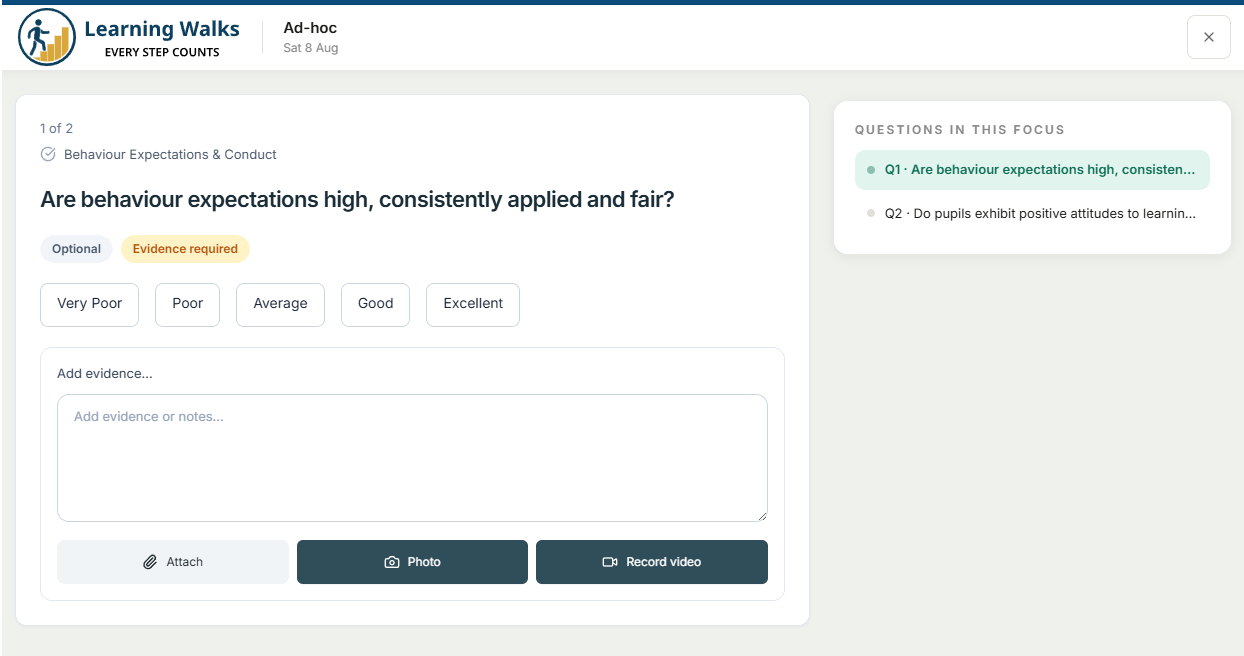
Rather than trying to evaluate everything happening in a lesson, a good learning walk starts with a clear purpose. Visitors look for agreed evidence, record what they see and combine findings across a number of visits.
Visits are deliberately brief and centred on a defined area, question or improvement priority.
Observers use a shared framework so evidence is gathered in a comparable way.
Notes and examples describe what was seen or heard rather than relying on unsupported impressions.
Leaders look across multiple visits to understand themes, strengths, variation and change over time.
The principle is the same in every setting: start with a useful question, gather consistent evidence across a number of visits, then look for the wider pattern. What changes is the context.
Explore practice across year groups, phases and curriculum areas without forcing a secondary-style structure.
See patterns across departments, subjects, year groups and classrooms while keeping a common evidence approach.
Adapt terminology, focuses and questions around your learners, provision and the priorities that matter in your setting.
Keep one improvement approach while allowing different phases or parts of the school to retain their own context.
Share frameworks and understand patterns across schools without creating false comparisons or losing local context.
A learning walk should help a school understand its practice, test whether improvement work is being seen in classrooms and decide what to explore next.
Build a picture across subjects, year groups, rooms or time periods rather than relying on isolated snapshots.
Explore how a teaching, curriculum or school-improvement priority is showing up in everyday practice.
Use recurring themes to shape professional development, coaching and wider improvement work.
Return to the same focus over time and see whether the evidence is changing as improvement work develops.
Both involve spending time in classrooms, but a learning walk is most useful when its purpose is broader than evaluating an individual lesson.
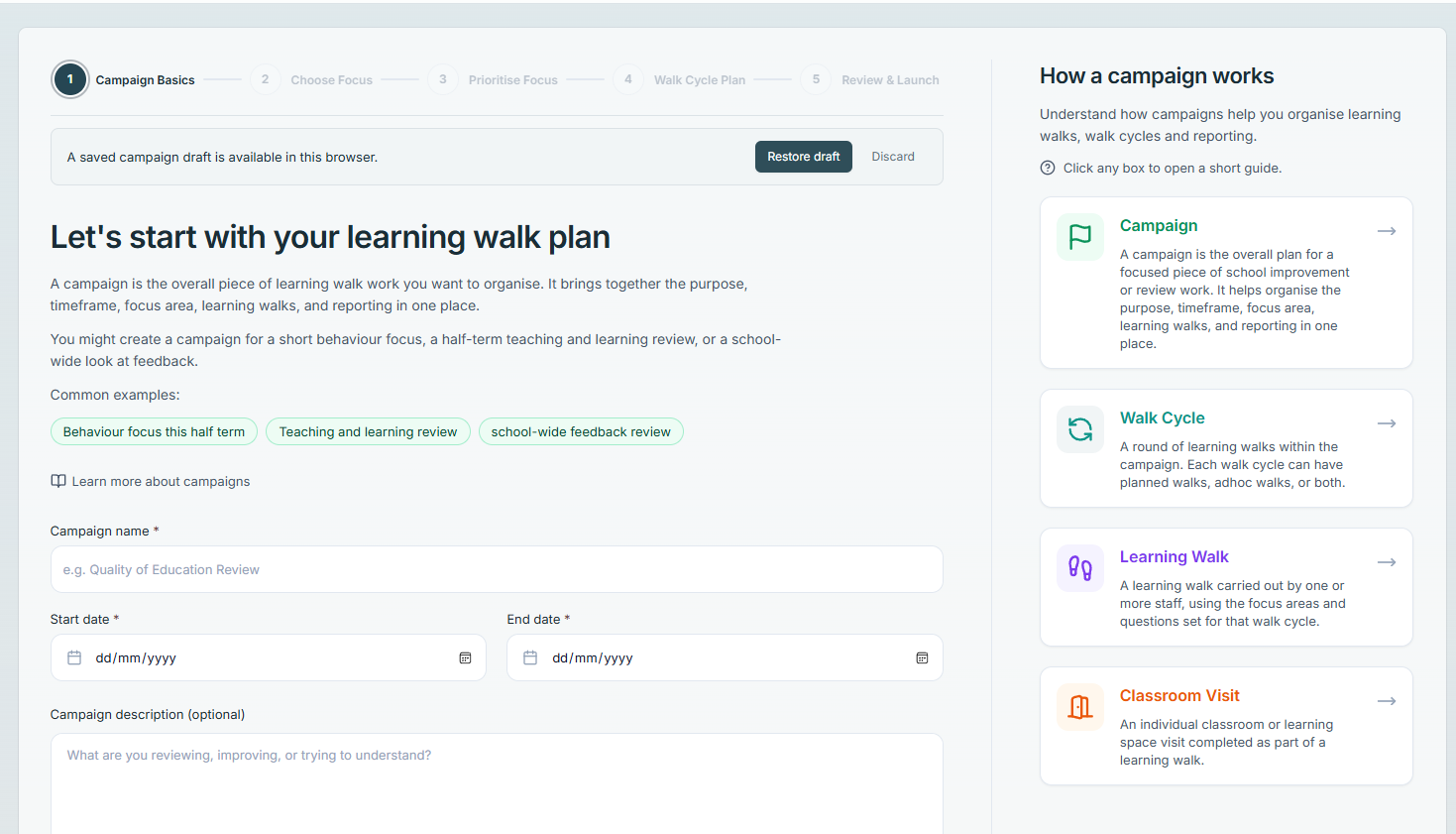
The technology should make a good learning-walk process easier to run — it should not decide the educational purpose for you.
Be explicit about what you want to understand and why.
Give observers shared prompts and a common evidence language.
Consider coverage, volume and quality before drawing conclusions.
Celebrate strengths, explore questions and connect findings to improvement work.
Plan the focus, capture evidence consistently, review what you have and understand the pattern — without adding another spreadsheet.